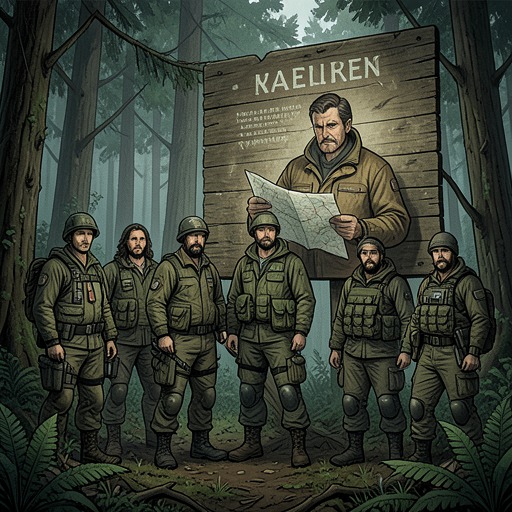
Helen signs up for the BCSC survival course
Happiness for BeginnersHelen Carpenter’s decision to take the BCSC survival course turns a post-divorce wish for dramatic self-renewal into a three-week test of practical judgment, endurance, and confidence. She expects to go alone into the Wyoming wilderness and return remade; instead, the course places her among strangers, brings Jake along unexpectedly, and makes the growth she wanted depend on real responsibilities rather than fantasy alone.
Background and Motivation
The course was meant to answer a loss Helen could not yet describe. After her marriage to Mike ended, she felt she had become someone she did not want to remain. She was not simply escaping her ex-husband; she wanted to recover from the person she had become in the wake of the marriage. Other divorced women had told her that divorce was the best thing that had happened to them, and Helen wanted to become one of those women. She resolved to attempt something wild, brave, and stupefying, though a survival course was a remarkably literal choice of cure.
Duncan first showed her the course catalog, but his recommendation was not what ultimately drew her in. A few restless nights later, Helen read a People magazine human-interest story about a man who had lost a leg in Afghanistan and rebuilt his life by completing the same course. He had even earned one of its prized Certificates, awarded to only the top three participants. His account of being lost and finding himself out there stayed with her. Helen did not believe that the Wyoming wilderness would necessarily return what she felt she had lost, but she needed somewhere to begin.
The course also answered her desire to prove something to herself. Duncan considered BCSC extreme and argued that experienced hikers planned their own trips instead of signing up for a packaged adventure. He had looked up reports of serious accidents and deaths in the hope of persuading Helen to choose something more reasonable. The warnings confirmed the kind of challenge she wanted: not a sensible retreat, but an undertaking that might amaze other people and, more importantly, herself.
The Decision and Its Risks
Helen’s resolve persisted despite the course’s reputation. BCSC was known for steep slopes, rocky routes, and remote locations; reports associated its trips with broken bones, rockslides, bear attacks, missing hikers, and hypothermia. Helen had signed roughly fifty waivers accepting the company’s responsibility exclusions for dangers ranging from bear attacks and avalanches to hypothermia and fatal diarrhea. The contrast was deliberate: she was a first-grade teacher choosing an expedition associated with thrill-seekers and people who had little left to lose, not someone whose usual life suggested a taste for wilderness risk.
She did not treat the danger as a reason to withdraw. She wanted the extreme and unreasonable experience, and she openly declared her ambition to earn a Certificate by placing among the trip’s top three participants. Jake challenged that expectation, but Helen answered with certainty. The award represented more than a distinction in the course: the story that had helped inspire her decision involved a participant who had used the experience to rebuild his life, and Helen hoped that she, too, could return with evidence of what she had managed to do.
The Solo Plan Meets Reality
In Helen’s imagination, the expedition had been taking shape for six months as an independent adventure with strangers. She pictured driving to Wyoming, conquering the challenge, and coming home fiercer and more self-assured. Her plan explicitly excluded everyone else, especially Jake, Duncan’s friend. When Jake told her that he was going on the same trip and expected a ride, she objected that the journey was something she was doing on her own. He pointed out that a course of twelve participants and an instructor would not leave her literally alone.
Jake’s arrival exposed the distance between the private story Helen had built around signing up and the actual circumstances of the course. She had expected a solitary break from her old life, but she would have to share the expedition with a group and with someone from her existing circle. She even tried to use her planned visit to Grandma GiGi as a reason Jake could not accompany her; he replied that Grandma GiGi loved him. The trip’s starting conditions therefore challenged her goal before the wilderness did: Helen could choose the course, but not shape it into the perfectly controlled, solitary transformation she had imagined.
Learning Through the Expedition
The course’s experiential approach made the decision consequential through action. Helen worried that she was under-educated and might lack information she needed before facing a problem. The response was that participants would learn as they went. In the wilderness, that meant bringing partial knowledge to situations where mistakes had real costs, rather than waiting until she felt wholly prepared.
When Hugh fell across a log and was pinned by his pack, Helen took off her own pack and tried to recall her first-aid training. Unsure how to proceed, she recognized that someone had to take charge and began trying to remove his pack. Later, she used her map-reading ability to realize that the group was heading the wrong way while she went to seek help. As she returned with the others, she identified those experiences—the attempt to help Hugh and the practical use of her three-dimensional map-reading skills—as good things within an otherwise terrible day. The course had begun to convert training into responsibility and responsibility into a more grounded sense of competence.
That development continued when Beckett put Helen in a group with Jake. He explained that she was accident-prone and headstrong, that Jake was the group’s medic, and that he trusted Jake to patch her up. He also paired them because Helen was the best map reader and Jake was nearly blind, and because Jake believed in her even when she did not believe in herself. During a later navigation crisis, Helen oriented the map correctly against her compass, then led her group back along the trail with confidence. They stayed together and reached camp first. These outcomes gave concrete shape to the self-trust she had sought when she signed up.
Return and Significance
At the end of the course, the group left the wilderness after a sunrise minute of silence and a farewell prayer led by Beckett. Helen’s response marked a change in how she met the course’s rituals: whereas early on she would have questioned Beckett’s seriousness, she now began applauding, and the others joined her. The shared hardship had also made the participants recognizable to one another through nicknames, although Helen remained simply Helen, or was sometimes called Ellen. The course’s community was real but did not erase her occasional feeling of being overlooked.
The expedition concluded with a vote for BCSC Certificates of Merit, given to the three students who consistently tried, paid attention, and improved the experience for others. The available account establishes the award criteria and that participants had voted by secret ballot, but not the final recipients. Helen’s decision therefore cannot be reduced to a confirmed prize. Its significance lies instead in the transformation from an imagined proof of fearlessness into a series of actual acts: attempting first aid, recognizing a navigation error, leading others, and finding grounds for gratitude even on a day she remembered as one of her worst. The course did not promise that she would recover herself simply by entering the wilderness; it gave her situations in which she could begin to discover what she was capable of doing.